Wasps, hornets and yellow jackets compared
Paper wasps are slender, with long legs that dangle in flight and open umbrella-shaped nests; yellow jackets are compact, bright yellow and black, and nest in the ground or walls; hornets are the largest, with big enclosed paper nests.
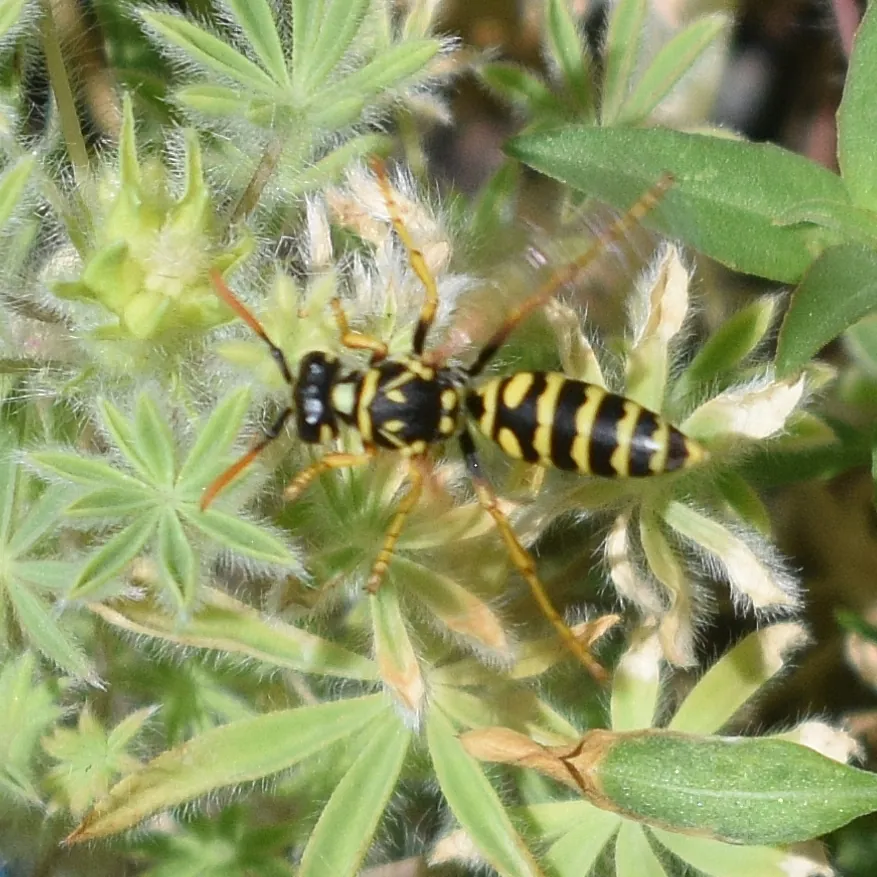
The quick tell
Look at the waist, the legs and the nest. A paper wasp has a very thin waist and lets its long back legs hang down as it flies. A yellow jacket is shorter and stockier, shiny bright yellow and black, and flies fast. Hornets are the biggest of the three. If you can see the nest, the shape settles it: open cells facing down means paper wasps; a closed paper ball or a hole in the ground means hornets or yellow jackets.
Paper wasps
Paper wasps are about 1 inch long. Most are brown or rust with yellow or red marks, but the common European paper wasp is yellow and black and is often mistaken for a yellow jacket. Check the waist; on a paper wasp it is pinched very thin. Their nests hang from a short stalk like an open umbrella, rarely larger than an outstretched hand, under eaves, gutters, shutters, porch lights and grill lids. Paper wasps are less defensive than yellow jackets and seldom sting unless the nest is touched.
Hornets
The two big "hornets" in US yards are different insects. The bald-faced hornet is black with a white face and white markings, about 1/2 to 3/4 inch long. It is actually an aerial yellow jacket. It builds a gray paper nest shaped like a bloated football, with one entrance at the bottom, hanging from trees, shrubs or the side of a building, and it defends that nest aggressively.
The European hornet is a true hornet, 1 to 1-1/2 inches long, brown and yellow with a reddish-brown head and thorax. It nests in hollow trees, attics, barns and wall voids. Unlike most wasps, it flies at night and is drawn to lit windows and porch lights. A larger, all-yellow-headed northern giant hornet is sometimes confused with it.
Yellow jackets
Yellow jackets are 1/2 to 1 inch long, with sharp yellow-and-black bands and a very narrow waist. Most nest in the ground, often in old rodent burrows, or in wall voids, crawl spaces and attics, and the main sign is a steady stream of wasps flying in and out of a hole. Colonies reach 1,500 to 15,000 workers by late summer, when they turn to sweets and garbage and show up at picnics. Extension entomologists rank them among the most dangerous stinging insects in the US.
Stings
All three can sting repeatedly, because their stingers are not barbed. Most stings cause pain, redness and swelling. About 2 million people in the US are allergic to insect stings. Hives, trouble breathing or swallowing, swelling of the face or throat, or dizziness need emergency care right away.
What to do about a nest
Leave nests alone if they are away from doors and paths; colonies die off in fall and old nests are not reused. For nests that must go, see wasp nests. Treat at night, never plug an entrance in a wall, and call a professional for nests in walls, high eaves or the ground near play areas.
Photos
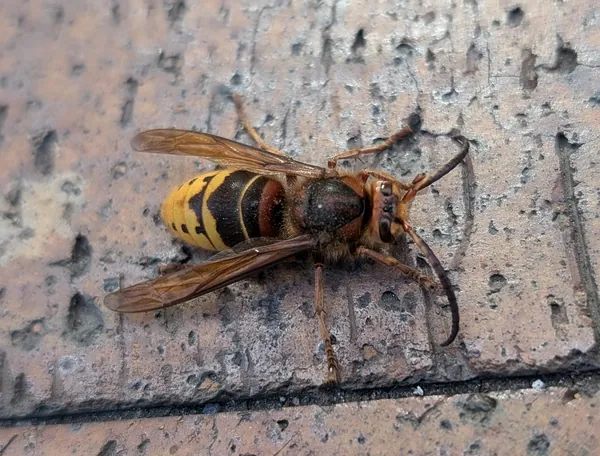
Side by side
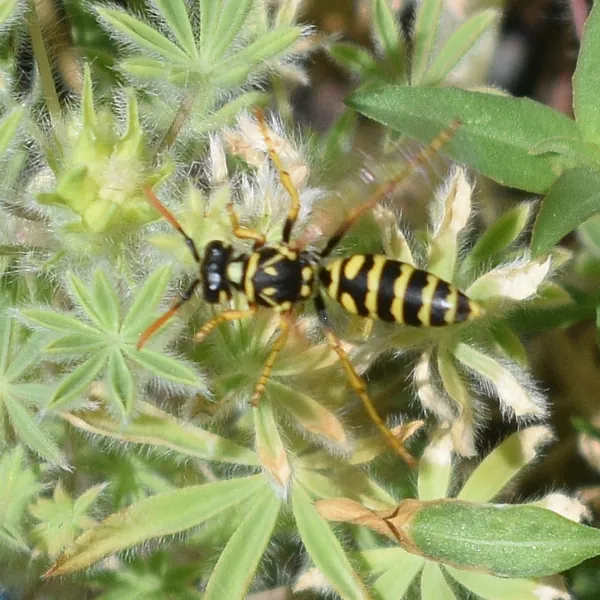 Paper wasp | 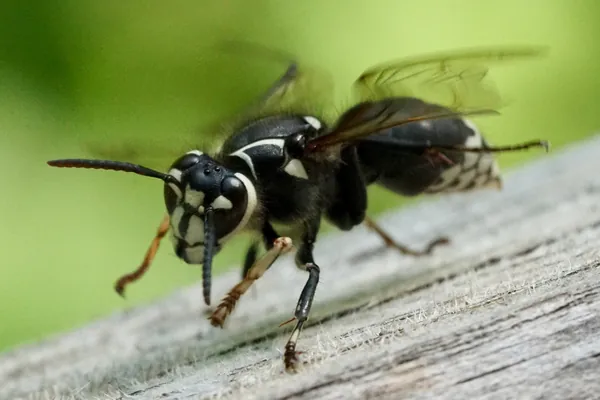 Hornet | 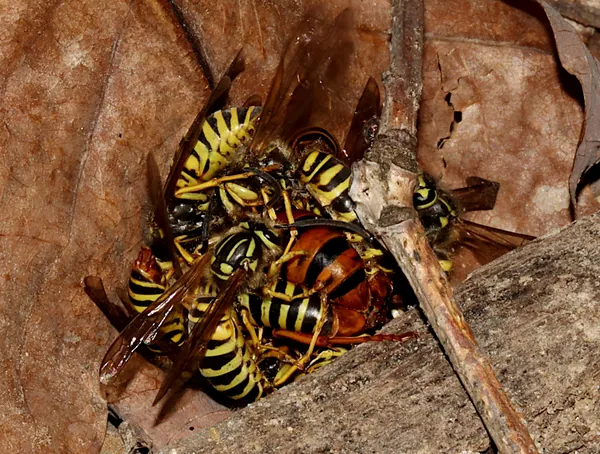 Yellow jacket | |
|---|---|---|---|
| Size | About 1 inch, slender | Bald-faced 1/2–3/4 inch; European 1–1.5 inch | 1/2 to 1 inch, compact |
| Colors | Brown to rust, or yellow and black | Bald-faced black and white; European brown and yellow | Bright yellow and black, jagged bands |
| Body | Very thin waist, long legs dangle in flight | Large and heavy-bodied | Short, stocky, nearly hairless |
| Nest | Open umbrella of paper cells on a stalk | Enclosed gray or brown paper; bald-faced is football-shaped | Enclosed paper, usually hidden |
| Nest site | Eaves, shutters, gutters, grills, mailboxes | Trees, shrubs, eaves; European in hollow trees and walls | Ground burrows, wall voids, attics, under rocks |
| Colony | 15–200 | Hundreds (European: 200–400 workers) | 1,500–15,000 by late summer |
| Temper | Rarely stings unless nest is touched | Very defensive near the nest | Defends nest hard; scavenges food late summer |
Photo credits: Paper wasp: Photo: Anne Parsons via iNaturalist, CC0 1.0 (public domain dedication); Hornet: Photo: Amy Schnebelin via iNaturalist, CC BY 4.0; Yellow jacket: Photo: Gordon C. Snelling via iNaturalist, CC BY 4.0.
When to call a professional
Call a pest professional for yellow jacket nests inside walls, attics or crawl spaces, for any nest you would need a ladder to reach, for bald-faced hornet nests larger than a football, and for anyone in the home with a known sting allergy. Professionals wear full protective suits and use long-pole dusters, which makes treatment much safer.
Questions
Is a yellow jacket a wasp or a bee?
A wasp. Yellow jackets are social wasps; they are nearly hairless and shiny, while honey bees are fuzzier and less brightly striped.
Is a bald-faced hornet a real hornet?
No. Despite the name, it is an aerial yellow jacket. The European hornet is the common true hornet in the US.
Which is more aggressive, a wasp or a yellow jacket?
Yellow jackets. Paper wasps rarely sting unless their nest is touched, while yellow jackets defend nests hard and forage around people's food in late summer.
Do hornets fly at night?
The European hornet does, and it is attracted to lights. Most other wasps stay in the nest after dark.
Sources
- Pest Notes: Yellowjackets and Other Social Wasps (UC IPM)
- Controlling Wasps, Hornets, and Yellowjackets (University of Kentucky Entomology)
- European Hornets and Look-Alikes (Ohio State University)
- Baldfaced Aerial Yellowjacket (Virginia Cooperative Extension)
- Yellowjackets in Virginia (Virginia Cooperative Extension)