What mouse droppings look like
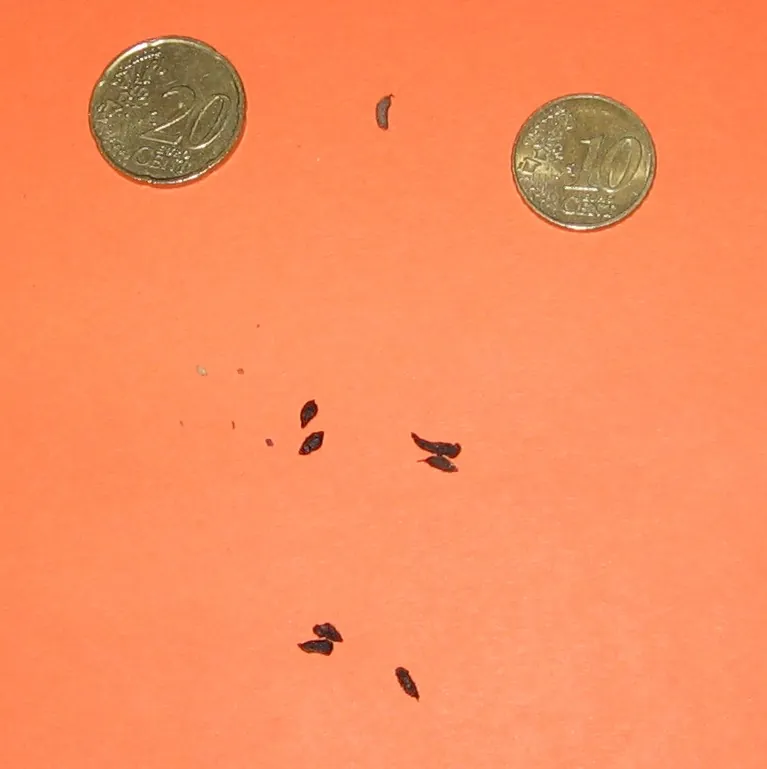
Mouse droppings are dark, smooth pellets 1/8 to 1/4 inch (3 to 6 mm) long, about the size of a grain of rice, with at least one pointed end, scattered along walls and in drawers and cabinets.
How to recognize them
Fresh mouse droppings are black or very dark brown, slightly shiny and soft. As they age they dry out and turn dull and grayish. Each pellet is 1/8 to 1/4 inch long, roughly the size of a grain of rice, and tapers to a point at one or both ends. The surface is smooth.
Mice drop pellets as they move, so you find them scattered along the routes they travel: the edge of a counter, the back of a drawer, the line where floor meets wall, around the dishwasher and inside the cabinet under the sink. One house mouse can leave 50 to 75 pellets a day, which is why a modest problem can look alarming.
Mouse droppings or something else
| Droppings | Size | Shape and surface | Usually found |
|---|---|---|---|
| House mouse | 1/8–1/4 in | Pointed end, smooth | Scattered along walls, in drawers |
| Norway rat | 3/4–1 in | Blunt ends, thick | Basements, ground floors, garages |
| Roof rat | 1/4–1/2 in | Curved, pointed, banana-shaped | Attics, high shelves, ceilings |
| American cockroach | Smaller than a rat's | Blunt ends, ridges along the sides | Damp basements, drains |
| German cockroach | Specks | Like ground pepper | Cabinet hinges and corners |
| Bat | About a grain of rice | Piles up below a roost or exit hole | Attic floors, under eaves, on siding |
The most reliable checks are size, ridges, and how the droppings are spread out. Rodent droppings are smooth; cockroach droppings have ridges along their length. Bat droppings pile up in one place below a roost or an exit hole, while mouse droppings are scattered along runways. The side-by-side is on rat vs mouse droppings, and every pest is on the droppings chart.
Fresh or old
To learn whether mice are still active, clean an area completely, then check it again in two or three days. New, dark, soft pellets mean current activity. Only gray, dry pellets mean an old problem that may already be gone.
How to clean up mouse droppings safely
Rodent urine and droppings can carry hantavirus. The CDC explains that the virus gets into the air when fresh droppings, urine or nesting material are stirred up, and people breathe it in. That is why the cleanup method matters more than the cleaning product.
- Open doors and windows and leave the room for at least 30 minutes to air it out.
- Put on rubber or plastic gloves.
- Spray the droppings, urine and any nest material until soaked, using a disinfectant or a fresh bleach solution: 1 1/2 cups of household bleach in 1 gallon of water (1 part bleach to 9 parts water).
- Wait 5 minutes, or as long as the disinfectant label says.
- Wipe everything up with paper towels and throw them in a covered garbage can.
- Mop or sponge the floor, counters, cabinets and drawers with disinfectant.
- Wash gloved hands, take the gloves off, then wash bare hands with soap and warm water.
Do not sweep or vacuum droppings, urine or nests. Both put particles in the air. Dead mice and nests go into a plastic bag, tied shut, inside a second tied bag. Wash bedding and clothing that mice reached in hot water and dry on high heat. Shampoo rugs and upholstery with a commercial disinfectant or a commercial-grade steam cleaner.
After the cleanup
Droppings tell you where mice travel. Put snap traps right where the heaviest droppings were, with the trigger against the wall, and seal gaps larger than 1/4 inch. The full plan is in how to get rid of mice.
Photos

When to call a professional
Call a professional cleaning or pest service for a heavy infestation, such as droppings across an attic, a cabin or shed closed up for months, or nests in insulation. The CDC advises extra protective measures in those settings, and contaminated insulation may need to be bagged and removed. If you get fever and muscle aches in the weeks after cleaning up rodent droppings, see a doctor and mention the exposure.
Questions
Can I vacuum mouse droppings?
No. The CDC says not to vacuum or sweep rodent droppings, urine or nests because it puts virus particles in the air. Soak them with disinfectant or a 1:9 bleach solution, wait 5 minutes, then wipe up with paper towels.
How many mice do I have if I find droppings?
You can't count mice from droppings. One mouse leaves 50 to 75 pellets a day, so a handful of droppings could be one mouse in one night. Fresh pellets in several rooms point to more.
How can I tell if mouse droppings are old?
Fresh droppings are black, shiny and soft. Old ones are dull, gray and crumbly. Clean an area and check it again after a few days to see whether new ones appear.
What if I touched mouse droppings?
Wash your hands well with soap and warm water. If you develop fever or muscle aches in the following weeks, see a doctor and tell them about the rodent exposure.
Sources
- How to Clean Up After Rodents (CDC)
- Preventing Hantavirus Disease (CDC)
- Identifying Mouse and Rat Damage (National Park Service)
- Identifying Your Pest With Poop (Cornell NYS IPM)
- Roof Rats: Identification, Ecology, and Signs (University of Arizona Extension)
- Living With Wildlife: Bats (Washington Department of Fish and Wildlife)