What wasp and hornet nests look like
A wasp nest is made of gray or tan paper: paper wasps hang an open, umbrella-shaped comb of cells from a short stalk, while hornets and yellow jackets build enclosed paper nests with one entrance, in trees, under eaves, in walls or underground.
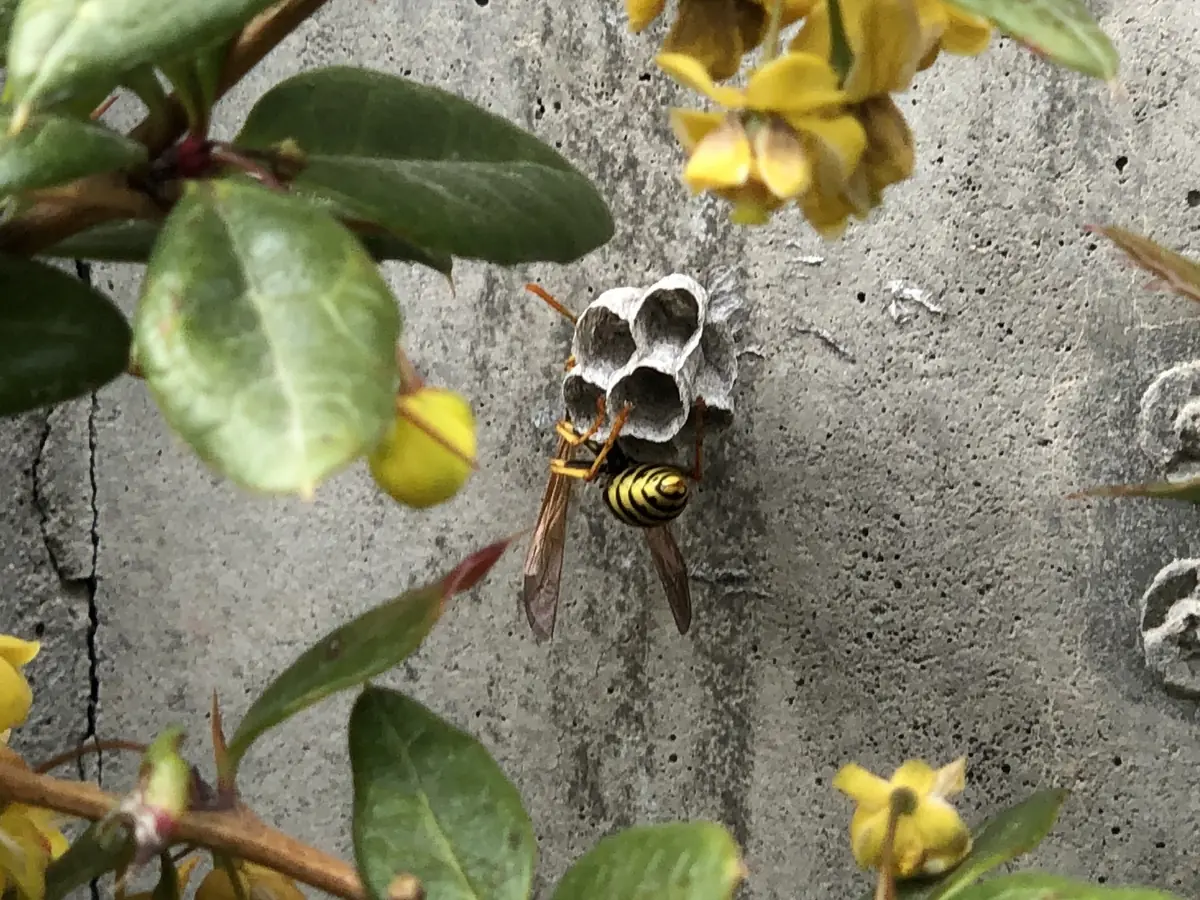
Paper wasp nests
Paper wasps build the nest most people picture: a single, open comb of paper cells hanging from a short stalk, like an upside-down umbrella. You can see the open cells from below. Nests rarely get bigger than an outstretched hand and hold 15 to 200 wasps.
Look under eaves, gutters, deck rails and window shutters, and inside porch lights, grill lids, mailboxes, sheds and attics.
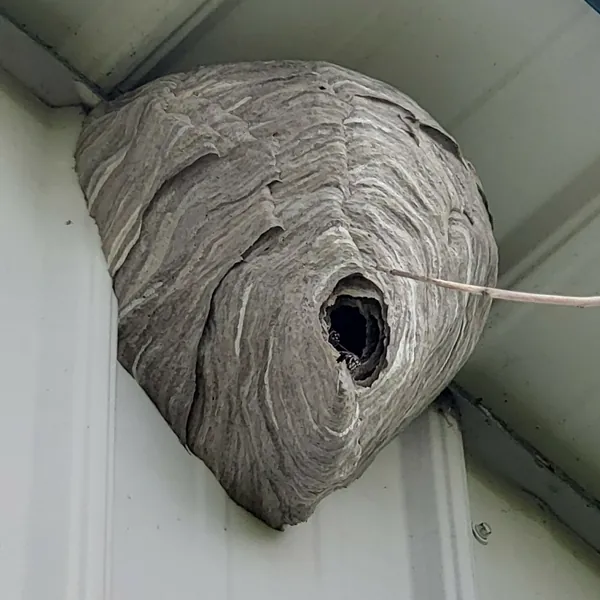
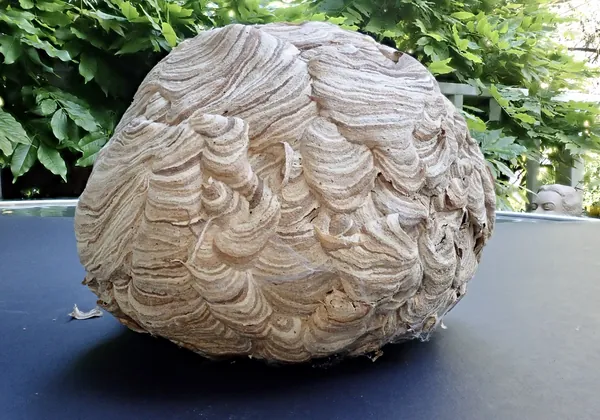
Bald-faced hornet nests
The bald-faced hornet, which is really an aerial yellow jacket, builds a large, enclosed gray nest shaped like a bloated football. The outside is a smooth, layered paper envelope with a single entrance hole near the bottom, guarded by a few workers. Nests hang from tree limbs, inside shrubs or on the side of a building, and are often hidden in thick leaves until fall. A colony can hold hundreds of very defensive wasps.
European hornet nests
European hornets nest in protected cavities, usually at least 6 feet off the ground: hollow trees, attics, barns, garages, wall voids and behind shutters. The nest is light brown paper and is often hidden, so the first sign may be large brown-and-yellow hornets at a gap in siding or at lit windows at night. A full-size nest holds about 200 to 400 workers.
Yellow jacket nests
Most yellow jacket nests are out of sight. In the ground they use old rodent burrows or spaces under rocks, landscape timbers and splash blocks; in buildings they fill wall voids, crawl spaces and attics. What you see is a hole, sometimes more than one, with a steady stream of wasps flying straight in and out. Inside is an enclosed paper nest that can hold 1,500 to 15,000 yellow jackets by late summer.
Mud dauber nests
Mud daubers build hard nests of mud, usually on ceilings and walls. Each is made by a single female. Mud daubers rarely sting and do not defend their nests, and old mud nests can be scraped off safely in winter.
| Nest | Looks like | Usual spot | Risk |
|---|---|---|---|
| Paper wasp | Open umbrella of cells | Eaves, shutters, grills | Low unless touched |
| Bald-faced hornet | Gray football, one bottom hole | Trees, shrubs, walls | High near nest |
| European hornet | Brown paper, hidden | Hollow trees, attics, walls | Moderate; active at night |
| Yellow jacket | Hole in ground or wall | Burrows, wall voids | High near nest |
| Mud dauber | Hard mud nest | Ceilings, walls | Very low |
The nest year
Only mated queens survive winter, sheltering in protected spots. Each starts a brand-new nest in spring. Colonies grow through summer and peak in late summer and early fall, when yellow jackets also become scavengers around food and trash. With cold weather the workers die, the paper breaks down, and the old nest is not used again. In mild southern winters or heated buildings, a few yellow jacket colonies can survive more than one year.
Remove it or leave it
A nest well away from doors, paths and play areas can be left alone; frost will finish it. For nests that must go:
- Catch paper wasp nests early. Knocking down a small spring nest often makes the founding queen leave.
- Treat at night, when wasps are inside, with full-length clothing, gloves and a veil. Point your light to the side of the entrance, not into it.
- Use a wasp and hornet spray that reaches from a distance for open and aerial nests, and an insecticide dust for ground and wall nests. Read and follow the label; the label is the law.
- Wait a few days before removing a treated nest, and retreat if wasps are still active.
What not to do
Never plug a nest entrance in a wall or siding; the wasps can chew through drywall into the house. Do not break open a bald-faced hornet nest. Do not use gasoline, fire or bleach, do not bury the nest, and do not blast it with a hose. These rarely work and can lead to many stings, a fire or both.
Photos
When to call a professional
Call a pest professional for yellow jacket or hornet nests inside walls, attics or crawl spaces, for any nest that needs a ladder, for large bald-faced hornet nests, and whenever someone in the household is allergic to stings. Professionals use protective suits and long-pole dusters and can remove indoor nests after the colony is dead.
Questions
What does a hornet nest look like?
A bald-faced hornet nest is a gray paper ball shaped like a football, with one entrance near the bottom, hanging from a tree, shrub or wall. European hornets hide brown paper nests in hollow trees, attics and walls.
Do wasps reuse old nests?
No. The colony dies in fall and each surviving queen builds a new nest in spring. In mild southern winters, a few yellow jacket nests can last more than a year.
Should I seal a wasp nest hole in my wall?
No. Plugging the hole can force the wasps to chew through the inside wall into your home. Treat the nest first, or call a professional.
When is the best time to spray a wasp nest?
At night, when the wasps are inside the nest. Wear protective clothing, since European hornets fly after dark and stings are still possible.
Sources
- Pest Notes: Yellowjackets and Other Social Wasps (UC IPM)
- Controlling Wasps, Hornets, and Yellowjackets (University of Kentucky Entomology)
- European Hornets and Look-Alikes (Ohio State University)
- Baldfaced Aerial Yellowjacket (Virginia Cooperative Extension)
- Yellowjackets in Virginia (Virginia Cooperative Extension)