What termite droppings look like
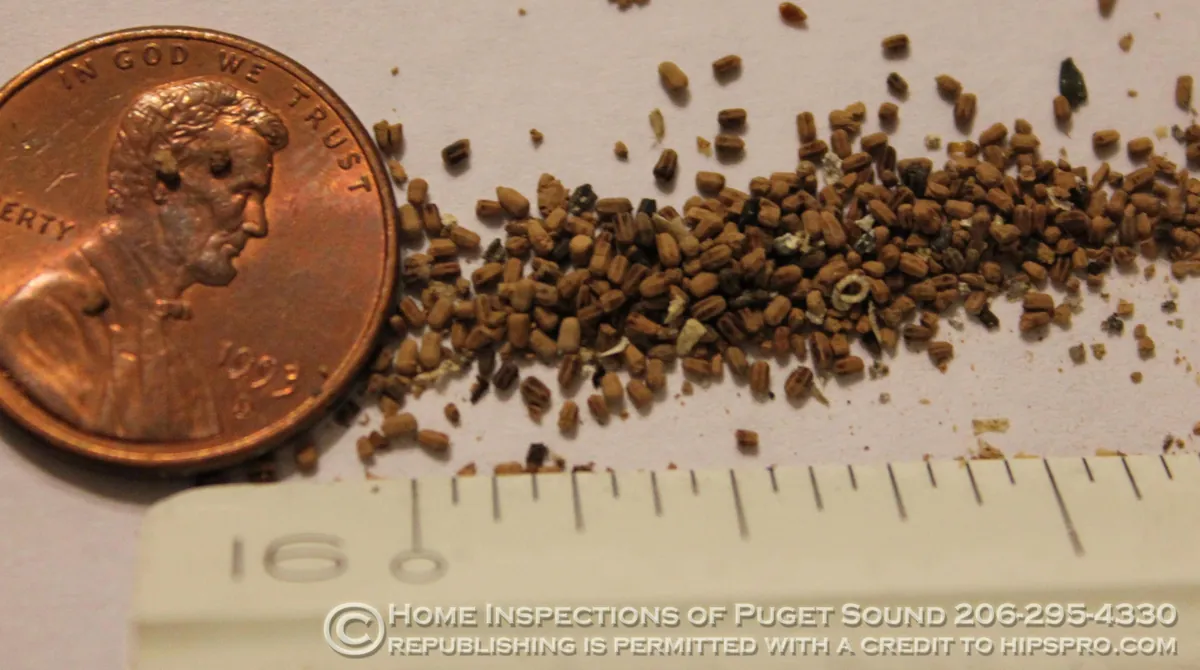
Termite droppings are hard, six-sided pellets about 1 mm long, no more than 1/16 inch, that drywood termites push out of tiny holes into small piles; subterranean termites do not leave pellet piles.
What the pellets look like
Drywood termite droppings, also called frass, are hard fecal pellets about 1 mm long, never more than about 1/16 inch (1.6 mm). One pellet is about the size of a grain of coarse sand. Under a magnifier each pellet is oblong with rounded ends and six flat or slightly dented sides separated by six ridges running lengthwise. That six-sided shape is the giveaway; no other common household pest leaves it.
Pellets can be black, cream or tan, and a pile often mixes light and dark pellets so it looks like salt and pepper. They feel gritty and do not squash between your fingers.
Where you find them
Drywood termites live inside the wood they eat and never go to the soil. To keep their galleries clean they push pellets out through kick-out holes smaller than 2 mm across, then often seal the holes again. The pellets fall and collect in little cone-shaped piles below the hole: on windowsills, baseboards, floors under door frames, inside cabinets, under furniture and in attics. A pile that comes back after you sweep it up is the strongest clue you have.
Why subterranean termites leave no pellet piles
Subterranean termites, the most common termites in the US, do not push pellets out of wood. They mix their feces with soil and chewed wood to build their mud tubes and to plaster the walls of their galleries. Their damage looks like hollowed wood lined with dried mud, not wood with sawdust or pellets underneath. If the termites in your house are subterranean, look for mud tubes and the other signs instead.
Lookalikes
| Debris | What it is | How to tell |
|---|---|---|
| Six-sided hard pellets | Drywood termite frass | Uniform size, ridged sides, gritty |
| Coarse, stringy shavings with insect parts | Carpenter ant debris | Fibrous like sawdust, mixed with dead ants and insulation |
| Football-shaped pellets with no ridges | Dampwood termite frass | Larger, rounded, in very wet or rotted wood |
| Uniform sawdust near fresh cuts | Carpentry or sanding | No holes above it, does not return |
Carpenter ant debris is the mix-up people make most often. Carpenter ants do not eat wood; they shred it and dump it out, so their piles look fluffy and fibrous. See carpenter ants.
Pellets alone do not prove termites are active
Old pellets can sit in a wall for years and fall out when the house shakes. Sweep or vacuum the pile, mark the spot, and check again over the next several days. New pellets in the same place suggest an active colony. Pellets turning up in several rooms suggest the infestation is spread through the house.
What to do
- Save a spoonful of pellets in a sealed bag for the inspector.
- Note every spot you find them; the number of locations helps decide between a spot treatment and treating the whole building.
- Book an inspection. Drywood colonies are hidden inside wood and often need a professional to find.
- Read termite treatment options. Products that control drywood termites in a building are not sold for home use.
Photos
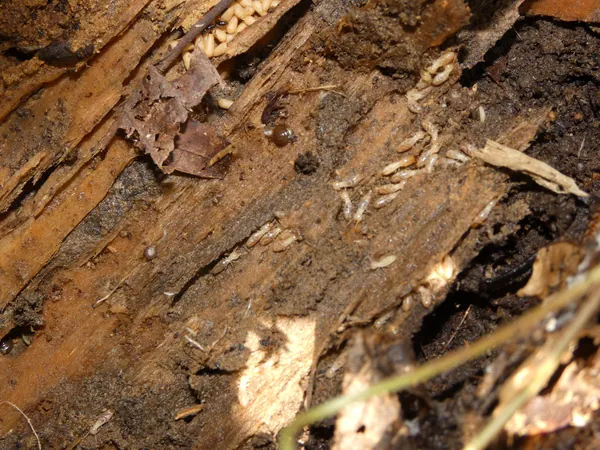

When to call a professional
Call a licensed termite company if pellets keep coming back after you clean them up, or if you find them in more than one room. A small infested item such as a picture frame can simply be removed. Anything in the structure needs a professional, because local injection treatments only work when the colony is found and widespread infestations need whole-structure fumigation or heat.
Questions
What do termite droppings look like?
Drywood termite droppings are tiny, hard pellets about 1 mm long with six flat sides. They collect in small piles that look like coarse sand or ground pepper.
Do subterranean termites leave droppings?
Not as pellet piles. Subterranean termites use their feces with soil to build mud tubes and line their galleries, so you see mud, not pellets.
Is termite frass the same as sawdust?
No. Termite frass is hard, uniform pellets. Fluffy, stringy shavings with insect parts are more likely from carpenter ants.
Does finding pellets mean termites are still there?
Not on its own. Clean them up and check again in a few days; new pellets in the same spot suggest an active colony.